← All work2025Food & drinkCopenhagen

Cellar Nine

Seasonal campaign and art direction

A wine importer with no retail presence and no advertising budget, given a campaign that ran entirely on the one surface they already owned: the bottle.

Client
Cellar Nine
Year
2025
Sector
Food & drink
Scope
Campaign strategy, art direction, print
Duration
11 weeks
Team
3 from the studio

Cellar Nine imports small-production wine to 200 Copenhagen restaurants. They have no shops, no shelf, no media budget and no interest in becoming a consumer brand. What they have is a hand on every bottle that reaches a restaurant table. We built a campaign that lived there and nowhere else.

01 — The problem

Everyone tastes the wine, nobody knows the importer

Cellar Nine's growers were the reason restaurants bought from them, and the reason was invisible. Sommeliers knew. Diners did not. When a restaurant dropped a grower, nothing in the room noticed.

A conventional brand campaign was both unaffordable and wrong — it would have addressed people who cannot buy from Cellar Nine at all.
02 — The thinking

The neck tag is the media buy

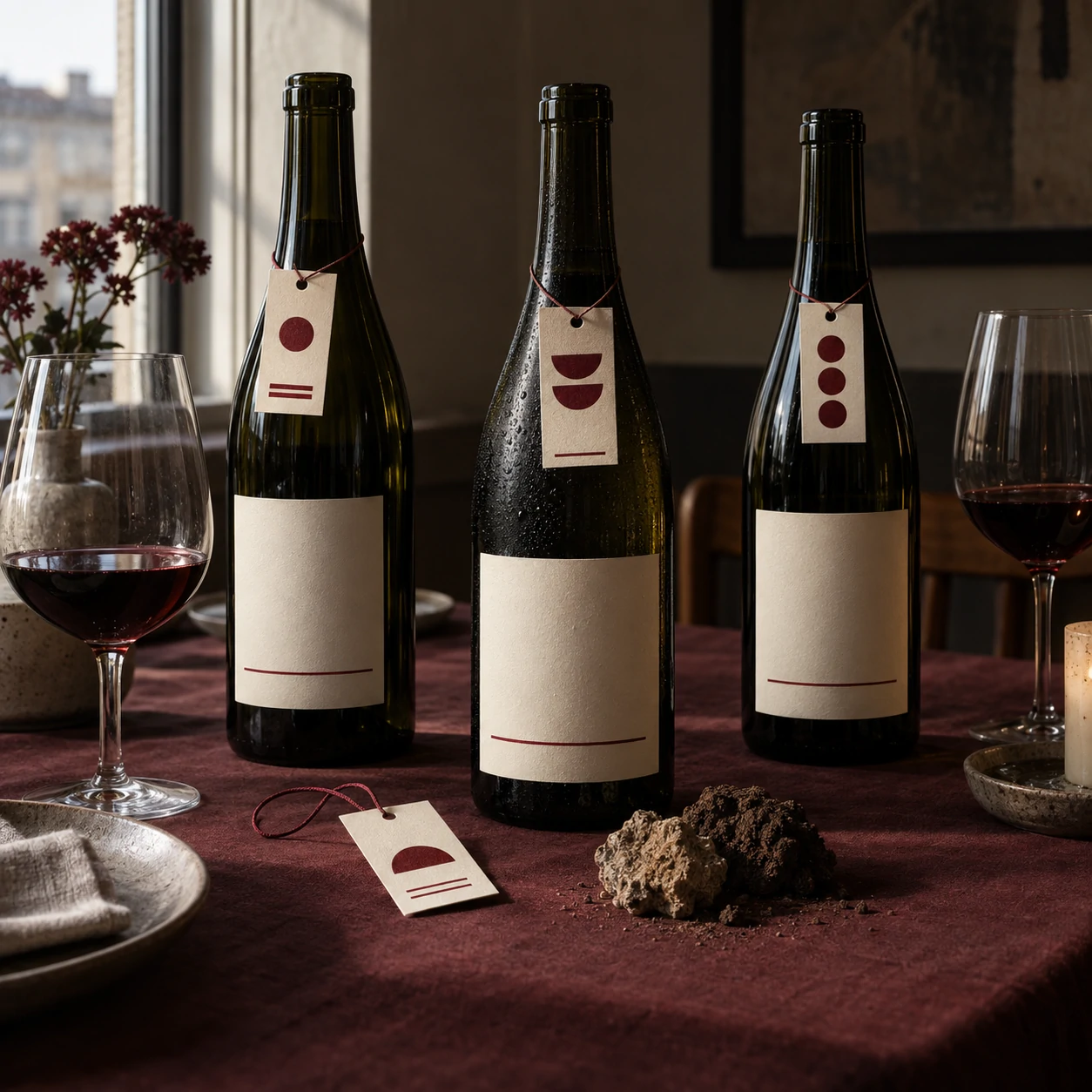
The campaign occupies the only surface Cellar Nine controls at the moment of drinking: a numbered neck tag on every bottle. Nine weeks, nine growers, one tag per week, each printed in a two-ink pairing built from the grower's own vineyard soil colour.

Because the tags are numbered and sequential, they became collectable without anyone being asked to collect them. Restaurants started pinning the run behind the bar.

Nine soil pairings, sampled on site

03 — The making

Letterpress, because it had to survive a wine bucket

Tags are letterpressed on 600gsm cotton board — heavy enough to sit in an ice bucket for an hour and come out readable. We proofed on press with the printer rather than on screen; three of the nine pairings changed at the proof stage because the overlap went muddy on damp stock.

Each tag carries the grower's name at a size usually reserved for the producer, and Cellar Nine's own mark at the size usually given to a distributor. That inversion is the entire campaign strategy expressed as a type hierarchy.

Type hierarchy — grower large, importer small

04 — The result

A campaign restaurants asked to continue

Eleven restaurants asked for the full set of nine to display. Cellar Nine has run the format every season since, which is the outcome a campaign should aim for — not a spike, but a habit.

Behind the decisions

What we chose, and what we argued against.

Why nine weeks

Long enough for a regular diner to notice a second tag; short enough that the restaurant never had to store more than one box.

Why no digital

Cellar Nine cannot sell to a diner. Spending on reach that could not convert would have been a vanity campaign with a report attached.

What the press proof changed

Three soil pairings overprinted to near-black on damp board. We re-sampled lighter seconds rather than switch to coated stock, which would have killed the tactile point.

Selected artefacts

From the work itself.

Outcome

What changed.

9

Growers named

Each given the largest type on the bottle.

200

Restaurant accounts reached

Zero media spend outside print.

4 seasons

Format still running

Re-commissioned every season since launch.

We asked for a campaign and they gave us a format. We are still using it three years later, which nobody warned us was possible.
Astrid LundPartner, Cellar Nine

Credits

Who made it.

Campaign strategy

Nadia Brandt

Art direction

Júlia Ferreira

Print production

Petra Lindqvist

Start a project

Have something like this in front of you?

A 45-minute call with the people who would do the work. If we are not right for it, we will say so and suggest who is.